Recent Posts
The Enduring Legacy of The Decoration of Homes
Posted by on
When Edith Wharton published The Decoration of Homes in 1897 with architect Ogden Codman Jr., she did more than write a guide on interior design principles. She redefined the relationship between architecture and interior design. More than a century later, her vision remains remarkably modern. Wharton believed that good design was not a matter of mere ornament, but of proportion, comfort, and human nature. Her conviction that interiors should be inseparable from architecture continues to influence how we think about harmony and home.
The Birth of a Design Philosophy
At the turn of the twentieth century, American interiors were laden with the exuberance of the Victorian era—heavy drapery, carved furniture, and rooms overflowing with bric-à-brac. The Decoration of Homes arrived as a quiet revolution. Wharton and Codman rejected the excess, calling instead for simplicity, proportion, and order derived from classical architecture. “The interior of a house,” they wrote, “is as much part of its organic structure as the outside.”
For them, decoration began with structure. Moldings, fireplaces, windows, and ceilings were not afterthoughts to be disguised but integral architectural features to be celebrated. Their approach insisted that beauty should emerge from form and function, not from accumulation. This philosophy marked the beginning of modern American interior design, an art guided by discipline and restraint rather than fashion.
The Mount: Wharton’s Vision Realized
Few artists have had the opportunity to live inside their own design theory. Edith Wharton did. Her Berkshire estate, The Mount, stands as a living embodiment of the principles set forth in her book. Designed in collaboration with Codman, the house is a study in proportion and elegance, its rooms flowing seamlessly from one to the next, each aligned with architectural purpose.
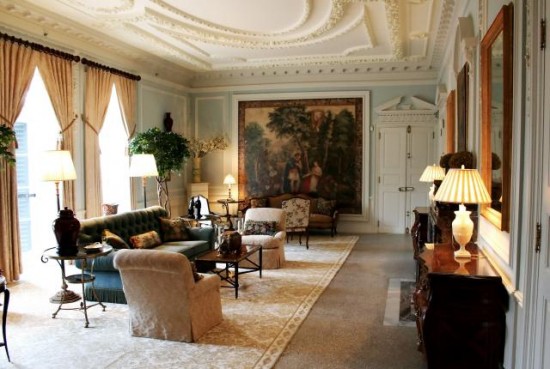
Today, The Mount remains a testament to Wharton’s refined sensibility. Its Drawing Room, reimagined by designer Charlotte Moss, continues the dialogue between tradition and interpretation. The suite once belonging to Wharton herself is being restored under the guidance of designer Michael Simon, reaffirming that her ideas are as alive now as they were a century ago.
The Classical Influence
Wharton’s insistence on harmony between structure and decoration echoed a lineage stretching back to the eighteenth century. Designers like Thomas Chippendale, Robert Adam, George Hepplewhite, and Thomas Sheraton had each drawn their inspiration from the classical proportions of ancient architecture. Their furniture designs were architectural in concept—columns translated into chair legs, pediments into cabinet tops, friezes into inlaid motifs.
For Wharton, these principles were not mere historical reference points but enduring truths about human perception. Spaces built on balanced proportion, she believed, brought comfort and clarity. Her advocacy aligned with the broader movements that followed, from the Arts and Crafts emphasis on craftsmanship and honesty of materials to the clarity of Modernism, which sought unity between structure and design.
The Blueprint of Taste
Even the structure of The Decoration of Homes reflects Wharton’s methodical mind. The book progresses from the general to the specific, beginning with architectural history and concluding with the most intimate details of daily living. No element was too small for consideration: walls, doors, floors, staircases, the drawing room, the boudoir, and even the placement of bric-à-brac were all examined with scholarly precision. The inclusion of an index and bibliography dating to the early seventeenth century further underscored her seriousness of intent.
This analytical rigor helped establish interior decoration as a discipline worthy of study rather than a hobby of personal taste. It also distinguished Wharton as one of the earliest women to claim intellectual and aesthetic authority within the world of design - a domain largely governed by male architects at the time.
A Living Legacy
Today, The Mount serves not only as a restored historic home but as a cultural and educational center dedicated to Wharton’s ongoing legacy. Visitors can step into her philosophy—rooms that embody proportion, restraint, and human scale. Her work reminds us that true beauty lies in coherence: when architecture and decoration exist in dialogue, not competition.
Edith Wharton’s ideas transcend style and era. They remind us that good design is not about imitation or excess, but about creating environments that express harmony, grace, and intellect. Whether one’s taste leans toward the classical or the contemporary, her message endures: a well-designed room should not only please the eye but also enrich the spirit.